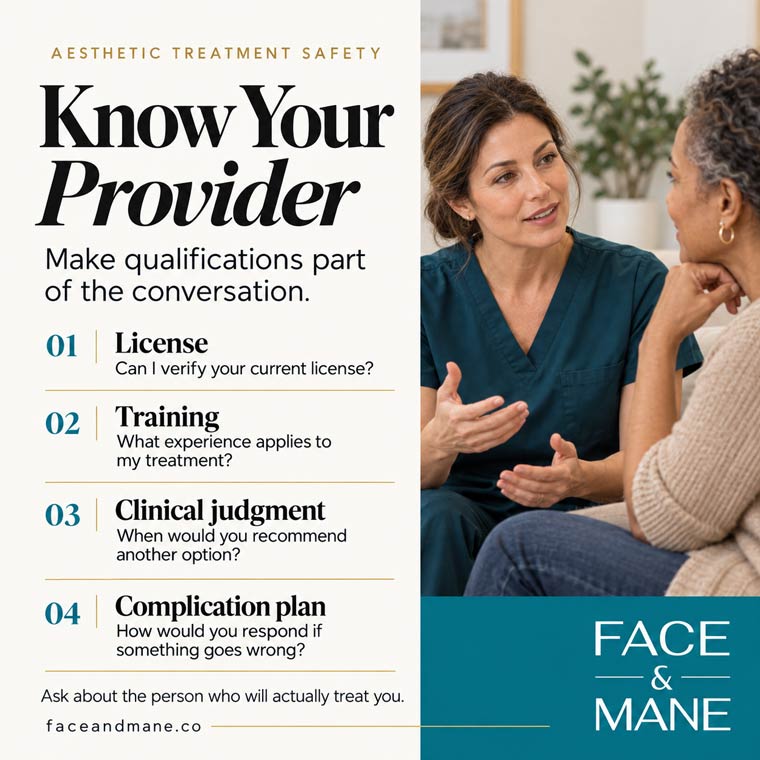
Safety begins with the expertise of your provider
Aesthetic treatments require an understanding of what lies beneath the skin. For injections, that means knowing the muscles, blood vessels, and tissue layers in the area being treated. It also means understanding the product and choosing an approach that fits your anatomy and goals.
Botox is one brand of botulinum toxin, a medicine used to temporarily reduce muscle activity. Other products include Dysport, Xeomin, Jeuveau, and Daxxify. CDC describes botulinum toxin treatment as safe when a licensed provider follows FDA guidance, including using an FDA-approved product and the recommended dose and injection approach. [1]
For fillers, FDA recommends a licensed healthcare provider with relevant experience, knowledge of facial anatomy, and training in managing complications. These qualifications help patients understand what professional expertise should include. [4]
Before choosing your provider, ask about their license and their experience with your particular treatment. You should be able to understand how their qualifications relate to the care you are considering.
A personalized assessment guides the right treatment
Professional care begins with understanding the individual. Your clinician should discuss your goals and review your health history, medications, allergies, previous treatments, and any factors that may affect the proposed procedure. The recommendation should explain what treatment can reasonably achieve and why it suits you.
That assessment also guides product selection. Dermal fillers and botulinum toxin work differently, and different products have different intended uses. An appropriate plan connects the product, treatment area, expected result, and your medical circumstances. [4]
Hair loss care starts with understanding the cause
Hair loss deserves a thorough assessment because treatment depends on its cause. The American Academy of Dermatology describes a diagnostic process that includes questions about your history and examination of the scalp and hair. Blood tests or a scalp biopsy may be appropriate when the findings suggest an underlying condition. [6]
This assessment creates a basis for discussing treatment options and realistic expectations. A clinician can explain whether home care is suitable, whether further evaluation is needed, and how progress should be reviewed. Results vary with the cause of hair loss and the individual’s response. [6]
Skincare should fit your skin
A professionally guided skincare plan should account for your skin type, concerns, and previous reactions. Even a product selected for your skin type can cause irritation or an allergic reaction. Clear instructions about introducing and using products help you put the plan into practice. [7]
Professional standards come into the home
In-home care needs deliberate preparation. CDC’s core infection prevention practices explicitly apply to healthcare delivered in homes as well as traditional healthcare facilities. They cover hand hygiene, environmental cleaning, medication safety, and other precautions relevant to the care being provided. [8]
For an appropriate home visit, the clinician should assess the space and explain what is needed. That includes adequate lighting, a clean working area, suitable seating or positioning, and freedom from interruptions. Pets and other distractions should be kept away from the treatment area.
Where injections are involved, proper preparation includes aseptic technique, appropriate sterile supplies, and safe handling of medicines. Products should come from authorized sources and be stored and transported according to their requirements. Ask your provider to explain these arrangements as part of your consultation. [1] [9]
The clinician should also determine whether the home can support the procedure’s equipment, monitoring, and emergency-response needs. When another setting is more suitable, recommending it is part of professional care.
Follow up is part of a well planned experience
Before the appointment ends, you should understand what to expect, how to care for the treated area, and who to contact with questions. Ask when progress will be reviewed and how concerns outside normal appointment hours are handled.
Professional care also includes an explanation of risks. Bruising and swelling can occur after injections. Fillers can rarely cause serious complications, including tissue injury or vision loss if blood supply is affected. These risks are reasons to choose a qualified clinician with a clear response plan. [4]
Your aftercare instructions should distinguish expected effects from symptoms requiring immediate help. Difficulty breathing or swallowing after botulinum toxin treatment requires emergency medical attention. Sudden vision changes, unusual pain, or white, gray, or blue skin near a filler injection site require immediate medical attention. [1] [5]
The Face and Mane approach to provider training
At Face & Mane, our provider training includes instruction and testing in the three-dimensional anatomy of the face, neck, and scalp, along with techniques for delivering aesthetic injections and treatments. This training is led by a facial surgeon with more than 30 years of experience in minimally invasive procedures of the face and neck.
Our priority is to help you feel confident in your care by understanding who will treat you, why treatment is recommended, and what you can reasonably expect.
Common Questions Answered by Doctor Hudak, MD, MHA
Can aesthetic care be provided safely at home
Yes, selected aesthetic care can be provided safely at home when the patient, procedure, and setting are appropriate and the required professional standards can be met. Your clinician should establish suitability before booking treatment.
What should I look for in an in home provider
Does safe treatment mean there are no risks
No. Safe professional practice includes explaining potential complications and taking appropriate steps to reduce and manage risk. Your clinician should help you weigh those risks against the expected benefits.
Do I need an assessment before hair loss treatment
Yes. Understanding the cause helps the clinician recommend suitable care, discuss realistic expectations, and decide whether further testing or specialist evaluation is needed. [6]